

Analysis
More than a decade after its launch, the Paks II investment is still in an early, uncertain stage, despite the fact that construction has formally begun. The project was initiated as a political decision in 2014, with questionable economic justification. Compared to the original deadlines, the investment has now accumulated an approximately 10-year delay. The 2026 “first concrete” milestone represents more of a formal change in status than real progress. Costs have increased significantly, and the total investment cost remains unknown.

The current state of the project shows that, despite the official start of construction, significant obstacles to implementation remain, and the future of the investment continues to be an open question. Overall, the completion, costs, and economic rationale of the project – affected by numerous serious risks, including geopolitical ones – remain highly uncertain.
The change of government in May 2026 provides an opportunity to assess the situation and make the necessary decisions after a comprehensive review of the project. Paks II is highly unlikely to be continued in its current form, but the government faces a difficult situation, as all available options involve significant risks, uncertainties, and expected costs.
Construction should be suspended during the review. From this point on, as much data and information as possible about Paks II must be made public, and the decisions taken after the review must be communicated clearly and transparently.
Background
Preparatory planning for the Paks II project began in 2008, and Parliament granted approval for the launch of the project in 2009. Although an international tender was promised in the following years, in 2014 the project was awarded to Rosatom without any tendering procedure. The intergovernmental agreement between Hungary and Russia on the matter, as well as the agreement on financing, were concluded at the beginning of the year, followed by the signing of the EPC (often called "turnkey" contracts, stands for Engineering, Procurement, and Construction) contract at the end of the year. The agreements provided for the turnkey construction of two new units with a capacity of 1,200 MW each (VVER-1200 type), with Rosatom as the main contractor, at a value of EUR 12.5 billion, financed 80% by a Russian loan.
The project was criticized from the outset: it was not preceded by a comprehensive economic and feasibility assessment; the selection of the Russian partner was politically motivated; it involves significant technological, financial, and geopolitical risks; and project management was unprepared to handle those risks.
The Energiaklub and other independent analysts highlighted the project’s structural problems, including contractual asymmetries and the general risks associated with nuclear investments, already at that time.
Delays in implementation
The project has experienced significant delays over the years. According to the original plans, the units should have started commercial operation by 2026 at the latest; however, by 2026 the project has accumulated roughly a decade-long delay. No detailed, official schedule has been made public, and the completion date is only referred to in vague, probably unrealistic estimates (“early to mid-2030s”).
The delays are not unexpected, as they are typical of nuclear investments. In the case of Paks II, key factors include EU procedures causing stoppages; nuclear licensing processes different from Russian practice, for which Rosatom proved unprepared; shortcomings in project management; the geopolitical context resulting from the Russia–Ukraine war; and a later requirement to build a concrete protection wall around the excavation pit to protect the operating Paks I reactors.
Costs have also increased significantly: the original EUR 12.5 billion budget is no longer realistic, and unofficial estimates suggest costs could reach up to EUR 25 billion; several related costs are also excluded from the official total estimate.
Overall, the economic rationale of the project has further deteriorated, not only due to cost increases, but also because of the rapid spread of renewable energy and energy storage technologies.
Status of the project
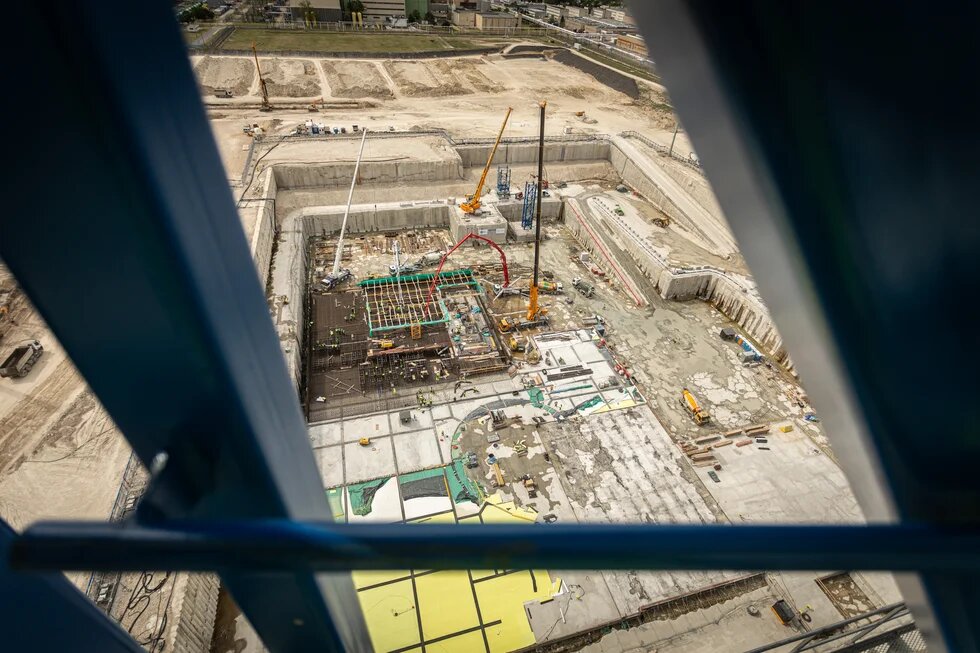
On 5 February 2026, the pouring of the so-called “first concrete” began for the first unit (Paks-5). According to the International Atomic Energy Agency, this means the project has officially entered the “under construction” phase.
However, this milestone does not indicate that the project is significantly closer to completion. Several similar “starting points” have already occurred (e.g. site preparation, ordering of major equipment), yet these have not accelerated progress. Only one unit is considered “under construction,” while the start of construction of the second unit (Paks-6) remains unknown, and the start of commercial operation is uncertain. Meanwhile, the project continues to face significant risks, and fundamental questions remain unanswered.
Key risks
In addition to the typical economic, financial, and feasibility risks associated with new nuclear power plants, further challenges characterize the project. These include geopolitical risks stemming from the Russian contractor and potential EU and US sanctions, which have so far been managed through ad hoc exceptions, but without guarantees for the future.
A particularly important issue is the loss of the instrumentation and control (I&C) system supplier (Siemens), which has created severe technological uncertainty. The I&C system is the core of the plant’s operation, and currently no solution is visible that would meet EU requirements.
Moreover, new legal uncertainty arose when, in September 2025, the European Court of Justice annulled the European Commission’s 2017 approval of state aid for the project. The case was brought by Austria, which challenged the approval. In its final judgment, the Court found that the European Commission had approved the state aid unlawfully by failing to properly investigate compliance with public procurement rules - namely, that Hungary had awarded the project to a Russian main contractor through a direct award without an open tender.
It remains unclear how the Commission will handle the situation; however, based on statements so far, it is possible that the issue of state aid for the project will be subject to a new comprehensive review, which could result in another “standstill” period lasting several years.
Considering these two recent, particularly concrete developments, it is especially unclear why Hungarian decision-makers did not take them into account and how the project could enter its officially “under construction” phase on 5 February. Overall, there is a concern that the dominant role of the Russian partner – i.e., the asymmetrical relationship embedded in the contracts – has contributed to this decision. This is not unprecedented: during the project, delays have already necessitated several modifications of deadlines and other conditions, and these changes have consistently been more favourable to the Russian side.
Review
The change of government in May 2026 offers an opportunity to reassess the situation and make decisions based on a full review of the project. This was pledged by the TISZA Party in its program, and a brief government decree laying the groundwork for it has already been issued. The construction must be suspended during this process. Independent experts should be involved, all possible scenarios must be examined, and maximum transparency should be ensured. The findings and consequences of the review must be communicated clearly and honestly.
Scenarios
In its current form, the Paks II project is unlikely to be continued and requires a fundamental reassessment. Given the situation created so far, the government faces a difficult position, as all available options involve significant risks, uncertainties, and likely costs.
The complete cancellation of the project would have legal and financial consequences, particularly due to already-ordered work and equipment. Compensation claims cannot be excluded, although the sanctions environment and force majeure arguments may mitigate these. Cancellation would also involve managing the consequences of abandoning the project, including handling partially-completed work.
Replacing the main contractor would imply introducing a new reactor type, effectively restarting the project. This would require new licensing procedures, EU investigations, and several years of delay, while parts of the already completed work would not be directly usable, resulting in additional costs.
Continuing with Rosatom would only be possible under significantly revised conditions; however, based on experience – delays, quality issues, sanctions risks, and the loss of key suppliers – this option appears to have limited feasibility.


